
Cut-to-Size Marble from Turkey: BOQ, Drawings, Tolerances & Export Guide (2026)
🖼️Blog Visuals
A cut-to-size marble order does not fail because a factory cannot cut a rectangle. It fails because the rectangle in the quotation, the rectangle in the approved drawing and the opening measured on site are not always the same rectangle.
That gap is where expensive mistakes begin: a vanity top arrives with the basin cut-out on the wrong side; stair treads are correct in length but carry the wrong nosing; wall panels are packed by size rather than installation zone; or a beautiful vein sequence is lost because nobody froze the slab layout before cutting.
Cut-to-size natural stone is therefore not just a product format. It is a controlled procurement workflow connecting design intent, current stone selection, fabrication instructions, quality control, packing and site installation.
This guide explains what an architect, contractor, importer or hotel procurement team should define before requesting a quotation from Türkiye—and what should be approved before any slab reaches the saw.
Quick answer: what is cut-to-size marble?
Cut-to-size marble consists of stone pieces fabricated to project-specific dimensions and details rather than supplied only as raw slabs or standard modular tiles. The scope may include:
Floor and wall panels
Stair treads, risers, skirtings and landings
Vanity tops, backsplashes and upstands
Shower walls and thresholds
Façade or cladding panels
Reception desks, counters and fireplace surrounds
Bookmatched feature walls
Pool copings, steps and special edge pieces
Depending on the project, each piece may require a defined thickness, finish, edge profile, vein direction, hole or cut-out position, joint relationship, piece code and crate destination.
The hard truth is simple: “Cut to the attached drawing” is not a complete specification. The drawing revision, material selection, finish, tolerances, visible edges, cut-outs, approval method, packing sequence and commercial scope must also agree.
Cut-to-size versus slabs and standard tiles
Supply form | What the buyer receives | Fabrication location | Main commercial risk |
|---|---|---|---|
Slabs | Large stone sheets for later fabrication | Usually at destination | Local cutting cost, yield and slab-selection risk |
Standard tiles | Repeated stock or project sizes | Mostly at origin | Limited customization and lot variation |
Cut-to-size | Finished pieces made to an approved schedule or drawing | Mostly at origin | Drawing, revision, tolerance, coding and packing errors |
Cut-to-size production can reduce destination-country fabrication and site cutting. It can also move more risk upstream. Once the stone is cut in Türkiye, an unresolved site dimension or drawing conflict becomes an international replacement problem.
That is why the cheapest square-metre quotation is not necessarily the lowest project cost.
When cut-to-size supply makes commercial sense
Cut-to-size is strongest when the project has repeated room types, controlled design details or expensive local fabrication. Typical examples include:
Hotels with repeated bathrooms, vanities and shower packages
Villas with bookmatched walls, staircases and bespoke floors
Commercial interiors with numbered wall or lift-lobby panels
Projects where local stone fabrication capacity is limited or costly
Phased projects requiring room-, floor- or zone-based deliveries
Importers supplying a defined contractor package rather than warehouse stock
It is a poor choice when site dimensions are not stable, design revisions are still moving, the installer has not reviewed the joint logic, or nobody has accepted responsibility for final fabrication drawings.
Do not use overseas fabrication to hide an unfinished design. It will expose the unfinished design in stone.
The 12 inputs required for a reliable quotation
A serious cut-to-size quotation begins with a controlled information package. The following items should be supplied or explicitly marked as pending.
1. Project and application
State the project type, destination country and exact use of the stone. A lobby floor, shower wall, pool coping, stair and ventilated façade do not carry the same performance, finish, edge or documentation requirements.
2. Stone reference and acceptable selection
Provide the preferred commercial stone name and a reference image or sample. Then define what the name alone cannot define:
Desired base colour and tonal range
Vein intensity and direction
Acceptable natural fissures, fossils or movement
Whether resin treatment or mesh backing is permitted or required
Whether the order must come from a matched block or production lot
Commercial names are not universal technical identities. Final approval should be tied to the current offered material, not an old catalogue photograph.
Explore the YaSeMarble natural stone collections to identify a starting material, then request current availability and lot visuals.
3. Drawing register and revision status
Send both a readable PDF and, where available, editable DWG/DXF files. The package should include a drawing register showing:
Drawing number
Drawing title or area
Current revision
Issue date
Approval status
One uncontrolled attachment sent through a message thread is not a production document. Before fabrication, the buyer, supplier and producer must all be working from the same approved revision.
4. BOQ or cutting schedule
The BOQ should identify each piece or repeated type with:
Item or piece code
Project zone, floor or room type
Length and width
Finished thickness
Quantity
Finish
Edge treatment
Cut-outs, holes or special processing
Drawing reference
If the drawing total and BOQ total disagree, production should stop until the discrepancy is resolved. Quietly choosing one document over the other is not project coordination.
5. Finished dimensions and site responsibility
State whether dimensions are:
Design dimensions
Verified site dimensions
Fabrication dimensions after joint deductions
Nominal modular sizes
The buyer and installer should confirm who owns final site measurement. A factory in Türkiye cannot verify an opening thousands of kilometres away unless reliable site data, templates or an agreed survey workflow are provided.
6. Thickness and calibration
Write the finished thickness and whether calibration is required. Do not assume “20 mm” means the same manufacturing condition in every quotation. For certain details, the project may also need a minimum thickness after surface finishing or a coordinated build-up with substrate, adhesive and joint depth.
7. Finish, cut direction and face
Name the finish once and use the same terminology across the BOQ, drawings and written specification. Examples include polished, honed, brushed, sandblasted, bush-hammered or tumbled.
For travertine and directional stones, define vein-cut or cross-cut. For every special piece, identify the visible face and visible edges. A polished top face does not automatically mean the front edge is polished.
8. Edge profiles, holes and cut-outs
Profiles should be drawn, not described only as “standard.” Show:
Chamfers and bevels
Bullnose or eased edges
Mitres and laminated build-ups
Drip grooves
Sink and hob cut-outs
Tap, socket or fixing holes
Corner radii
Underside polishing or reinforcement where specified
For critical openings, include dimensions from fixed datums rather than chained measurements. Confirm whether the project will provide physical templates.
9. Joint, pattern and vein logic
A beautiful individual panel can still produce a poor wall. Define whether pieces are:
Randomly blended
Directionally laid
Bookmatched or vein-matched
Dry-laid for approval
Sequenced by elevation, room or floor
The drawing should show joint width and panel orientation. If the design requires continuity, approve the proposed slab allocation or dry-lay record before cutting or packing, depending on the production sequence.
10. Tolerances and acceptance criteria
Never copy a generic tolerance from another project. Required tolerances depend on product form, size, finish, edge detail, installation system, applicable standard and the producer's confirmed capability.
The purchase specification should state how the following will be checked:
Length and width
Thickness
Squareness and diagonals
Flatness or warpage
Edge straightness
Hole and cut-out position
Surface finish and visible defects
Shade and vein range
For EU construction products, the applicable product standard depends on the supplied form—for example, standards commonly referenced include EN 12057 for modular tiles, EN 12058 for floor and stair slabs, and EN 1469 for cladding slabs. The project team should confirm the applicable standard, declared performance and local acceptance requirements for the exact use and destination.
11. Quantity, waste and spare stock
Separate three figures:
Net installed quantity
Production or cutting allowance
Handover spare stock
Do not hide all three inside one rounded total. Complex patterns, diagonal layouts, strong vein matching and fragile narrow pieces may require different allowances. The installer or project quantity surveyor should approve the basis.
12. Delivery programme and commercial term
State the required delivery window, shipment phases, destination and the Incoterms® rule with a precise named place or port and version—for example, “FCA [named terminal], Incoterms® 2020,” not simply “FCA Turkey.”
For containerized cargo, FCA, CPT or CIP may be operationally more appropriate than maritime-only rules in some transactions. The right term depends on who controls carriage, insurance, documentation and the transport chain. Confirm it with the parties' freight and trade advisers rather than choosing a familiar three-letter term by habit.
A controlled cut-to-size workflow
Step 1 — Feasibility and source routing
The first review should test whether the proposed material, quantity, dimensions, finish and programme can be produced together. Large panels, narrow pieces, unusual finishes, fragile cut-outs and strict visual matching can change the appropriate block, factory route, reinforcement and packing plan.
As a multi-producer sourcing desk, YaSeMarble can compare suitable Turkish production routes rather than forcing every package through one quarry or factory. The selected producer and scope should nevertheless be fixed in the dated quotation.
Step 2 — Current material review
Review current slabs, bundles or representative production material. For visually sensitive projects, agree a physical control sample and, where practical, lighter and darker range samples.
The approved sample defines the target; the agreed range defines the reality of natural stone.
Step 3 — Drawing and BOQ reconciliation
Before production release, check the drawing register against the BOQ and quotation. Confirm quantities, codes, finishes, thicknesses, visible edges, cut-outs and revision numbers.
Any exclusions should be written. If shop-drawing development, site measurement, structural engineering, anchoring design or installation is outside the supplier's scope, say so before the deposit—not after a problem.
Step 4 — Sample, prototype or mock-up approval
Not every order needs a full mock-up. Complex pieces often do. A vanity, stair nosing, mitred corner, pool coping or façade detail may justify a prototype before volume production.
Approve the geometry and workmanship separately from the natural colour range. One sample cannot prove both dimensional repeatability and the full visual range of a large order.
Step 5 — Production release and change control
Release production only against a named drawing revision and written approval. After release, any change should record:
The revised item
Quantity affected
Material already cut
Cost impact
Programme impact
New approval status
An informal message reading “move the hole slightly” is not change control.
Step 6 — Inspection and visual layout
Inspection scope should be agreed in the order. Depending on the package, it may include:
Dimensional checks against a sampling plan
Thickness and edge-profile checks
Finish comparison
Current-piece photographs or video
Dry-lay or elevation layout for selected visible areas
Third-party inspection arranged by the buyer
A dry-lay photograph is valuable only when it identifies the drawing, area, revision, date and piece codes. Otherwise it is a nice image with weak contractual value.
Review YaSeMarble's quality-control and export-packing workflow before agreeing the inspection package.
Step 7 — Piece coding and crate mapping
Every complex piece should carry a code that also appears on the BOQ, drawing and packing list. Crates should be grouped according to the installation logic agreed with the contractor—by floor, room, elevation, zone or sequence.
Good packing protects the stone. Good coding protects the programme.
Step 8 — Packing, loading and documents
Define the crate or bundle basis, separators, edge protection, moisture protection where applicable, fumigation requirements, lifting points, package weights and shipping marks.
Before dispatch, reconcile the final packing list with the produced quantities and crate map. For container planning, thickness, density and packing weight matter more than empty container volume; see YaSeMarble's container capacity guide.
The export-document package should match the order, destination and product form. Do not assume every certificate is relevant to every stone, source or country.
Risk checklist by application
Application | Details most often missed before production | Approval that reduces the risk |
Hotel vanity tops | Basin model, tap holes, backsplash, visible edges, handed pieces | Approved prototype and room-type code |
Stair package | Nosing profile, tread direction, riser thickness, landings, slip requirement | Full stair schedule and edge sample |
Feature wall | Panel joints, vein direction, bookmatch sequence, socket cut-outs | Numbered slab layout or dry-lay |
Floor pattern | Joint width, borders, transitions, movement joints, net versus waste quantity | Area drawing and coded cutting list |
Pool coping | Radius, drip groove, exposed edges, finish, local wet-use requirement | Profile sample and coordinated plan |
Cladding panels | Panel size, anchoring interface, performance data, engineering responsibility | Engineer-reviewed system and panel schedule |
What changes the price of cut-to-size marble?
The raw stone is only one component. A useful quotation should show or clearly define the cost basis affected by:
Stone type, current selection and block yield
Finished thickness and panel dimensions
Surface finish
Edge polishing and special profiles
Holes, cut-outs, grooves and mitres
Resin, mesh or reinforcement where agreed
Bookmatching, dry-lay or visual sequencing
Inspection and documentation scope
Piece coding and project-specific packing
Crate count, internal transport and loading plan
Delivery term and named place
Production phasing and remakes caused by later revisions
Two suppliers can quote the same square-metre rate while pricing different scopes. Compare the written inclusions, exclusions, approved reference and risk-transfer point—not the headline number alone.
What a complete YaSeMarble quotation should let you verify
Before payment, the commercial offer should allow both parties to answer:
What exact stone and current source are being offered?
What visual selection has been priced?
Which drawing and BOQ revision controls production?
Which dimensions, thickness, finish, edges and special processing are included?
Which tolerances or applicable product standard will be used?
Is sampling, prototyping, dry-lay or third-party inspection included?
How will pieces and crates be coded?
What packing basis is included?
What quantity and shipment phases are priced?
Which documents can be supplied for the offered source and destination?
Which Incoterms® rule, named place and version apply?
What are the payment terms, offer validity, programme and written exclusions?
See How We Trade for YaSeMarble's commercial framework and inspection principles.
Copy-and-paste cut-to-size RFQ template
Use the structure below when requesting a project quotation.
Project name:
Project type: Hotel / villa / commercial / public / other
Destination country and city:
Required delivery window:
Preferred delivery term and named place:
Stone name or reference:
Intended application:
Required visual selection:
Product form: Floor panels / wall panels / stairs / vanities / cladding / other
Finished thickness:
Surface finish:
Cut direction: Vein-cut / cross-cut / not applicable
Visible edges and profiles:
Holes, cut-outs or grooves:
Net quantity:
Allowance and spare stock:
Drawing numbers and current revisions:
BOQ attached: Yes / No
Site dimensions verified: Yes / No / Pending
Control sample required: Yes / No
Prototype or mock-up required:
Dry-lay or layout approval required:
Piece-coding basis: Room / floor / elevation / zone / other
Required tests or documents:
Inspection requirement: Supplier QC / buyer inspection / third party
Packing or delivery restrictions:
Contact person for technical clarifications:
Attach the PDF drawings, editable CAD files where available, BOQ spreadsheet, finish references, edge details and current revision register in one controlled package.
Why source cut-to-size stone through YaSeMarble?
YaSeMarble operates as a buyer-focused Turkish natural stone sourcing and export coordination desk. We are not limited to selling the current output of one quarry. For a qualified cut-to-size enquiry, we can route the specification to suitable producers within our network, compare current material availability, align the written production scope and coordinate pre-shipment evidence against the agreed order.
That does not remove the buyer's responsibility to approve drawings, site dimensions, engineering or local-code requirements. It creates one accountable commercial contact for the Turkish sourcing, production and export side of the package.
For the broader import process, read How to Import Marble from Turkey.
Frequently asked questions
Can YaSeMarble quote from an architectural drawing?
An architectural drawing can support an initial review, but it may not be fabrication-ready. The quotation should state whether detailed stone shop drawings or cutting schedules are supplied by the buyer, developed by the selected producer, coordinated by another specialist or excluded. Final responsibility must be agreed before production.
Which files should I send for cut-to-size marble?
Send readable PDF drawings, DWG or DXF files where available, an Excel BOQ or cutting list, the drawing register, material and finish references, edge-profile details and the required delivery programme. Identify the current revision of every file.
Can cut-to-size marble be bookmatched or vein-matched?
Yes, subject to the material, available slab size, quantity and agreed layout scope. Bookmatching should be approved against the current slabs and a numbered layout before irreversible cutting.
Are fixed dimensional tolerances available for every order?
No single tolerance is correct for every product. The applicable standard and project tolerance depend on the product form, dimensions, finish, edge detail, installation system and destination requirements. The offered producer must confirm capability before the tolerance becomes contractual.
Can pieces be packed by hotel room or project floor?
Yes, when room-, floor- or zone-based coding is included in the approved BOQ, drawings, packing scope and crate map. It should be agreed before production because project-specific sorting and packing affect time and cost.
Is dry-lay approval required for every cut-to-size order?
No. Repeated standard pieces may not need it. Bookmatched walls, strong directional stones, borders, medallions and visually sensitive public areas may benefit from dry-lay or a digital slab-layout approval. Define the exact areas and approval record instead of requesting a vague “full dry-lay.”
Is FOB always the best term for Turkish marble containers?
Not automatically. FOB is a maritime rule, while containerized stone usually moves through a multimodal chain. FCA, CPT or CIP may be more appropriate in some transactions. The parties should select the Incoterms® 2020 rule, named place and insurance arrangement that match the actual transport and banking workflow.
Turn your drawings into a controlled quotation
Send YaSeMarble your material reference, BOQ, drawings, finish, thickness, quantity, destination and required delivery window. We will review the project scope, identify the information still missing and coordinate a dated quotation route with suitable Turkish producers, subject to current material and production availability.
Request a Cut-to-Size Project Quotation
WhatsApp: +90 552 802 22 00
Email: info@yasemarble.com
Internal linking plan
Anchor text | Destination | Purpose |
YaSeMarble natural stone collections |
| Move design-stage readers into products |
quality-control and export-packing workflow |
| Prove operational controls |
container capacity guide | Existing container article | Support logistics planning |
How We Trade | Existing payment/tolerance article | Support commercial trust |
How to Import Marble from Turkey | Existing import guide | Build the procurement content cluster |
Request a Cut-to-Size Project Quotation |
| Primary conversion |
Required on-page conversion block
Place a compact form after “The 12 inputs required” and repeat it after the FAQ. Do not use only a generic contact form. Ask for:
Company and country
Project type
Stone or reference image
Quantity
Thickness and finish
Destination
Required date
BOQ/drawing upload
Recommended real-image sequence
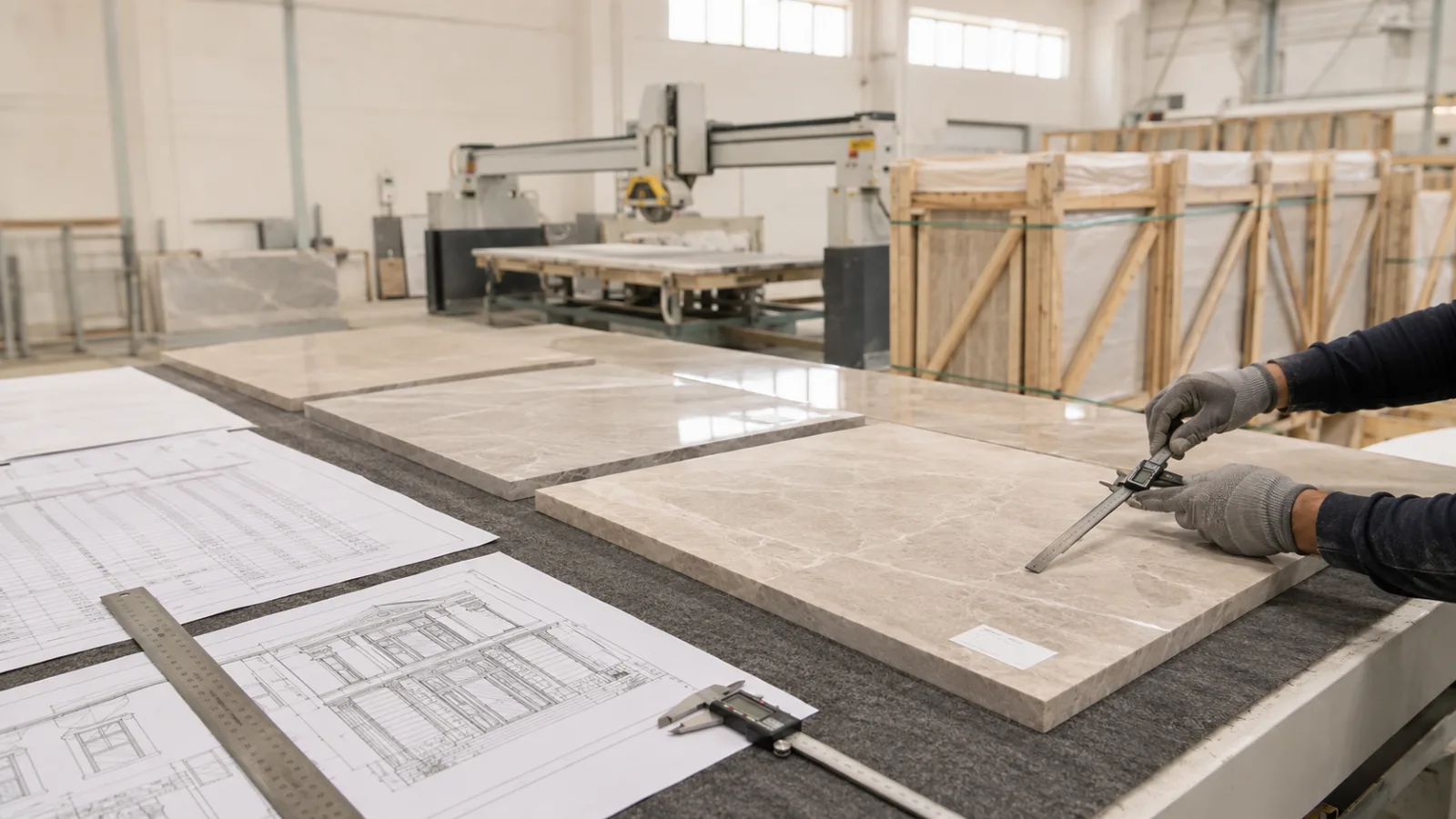
Hero: Coded finished marble panels checked against a printed drawing
Current material approval: Actual slabs or bundles with lot reference
Production: Bridge-saw/CNC cutting or edge processing
Quality control: Dimensional check with piece code visible
Visual approval: Dry-lay or numbered panel layout, if available
Export: Crate code, packing list reference and protected pieces
Each image should have a factual caption naming what is being checked. Avoid generic captions such as “premium quality marble.”
Suggested FAQ schema questions
What is cut-to-size marble?
Which files are required for a cut-to-size marble quotation?
Can cut-to-size marble be bookmatched?
How are project marble pieces numbered and packed?
Is dry-lay approval required?
Which Incoterm should be used for marble containers?