
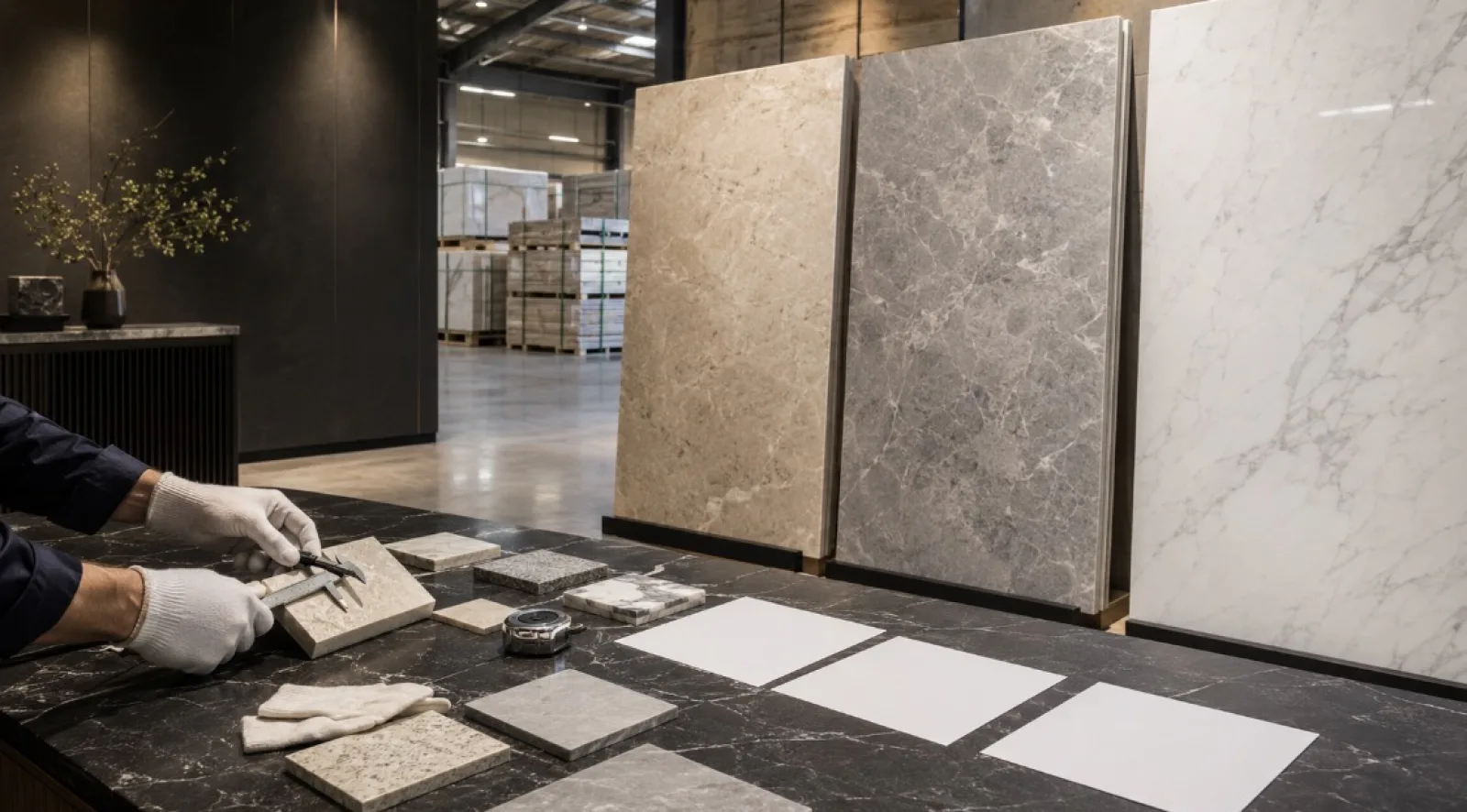
How to Compare Turkish Marble Quotes: 12 Checks Before You Choose a Supplier
🖼️Blog Visuals
How to Compare Turkish Marble Quotes: 12 Checks Before You Choose a Supplier
Two suppliers can quote the same Turkish marble at two very different prices and both figures can be technically correct.
The problem is that they may not be quoting the same selection, source, slab size, finish, treatment, packing, delivery point or inspection scope. The commercial name may match while almost everything that determines the final result is different.
That is why the lowest price per square metre is not automatically the lowest-cost order. A cheaper offer can become more expensive through poor usable yield, rejected pieces, extra sorting, repacking, project delays or a delivery term that excludes costs included by another supplier.
The solution is not to stop comparing prices. It is to compare like with like.
This guide shows international buyers how to turn several Turkish marble quotations into one defensible purchasing decision.
1. Confirm the exact stone identity
A commercial stone name is a starting point, not a complete specification. Similar-looking materials may be sold under overlapping trade names, while one well-known name may be produced from different quarry areas or processed by different factories.
Every quotation should identify, as far as commercially available:
● the commercial stone name;
● the stone type: marble, travertine, limestone, onyx, granite or quartzite;
● the source or quarry region;
● the producer or processing factory;
● the offered production lot or current stock basis.
Do not compare “Tundra Grey” with “Tundra Grey” until both suppliers have defined what they are actually offering.
2. Replace grade adjectives with an approved selection range
“Premium”, “first quality”, “standard” and “commercial” are not universal visual grades. Different producers can use the same adjective for visibly different selections.
A stronger quotation defines the acceptable range through evidence:
● current slab, bundle or tile photographs;
● a representative video showing more than the most attractive face;
● a physical control sample where practical;
● light, typical and dark range samples for larger projects;
● written limits for veining, shade, open fissures, repairs, filling and mesh backing.
Natural stone will vary. The commercial question is not whether variation exists, but whether the permitted variation has been agreed before production.
3. Ask whether the visuals show current material
A catalogue image proves that a stone exists. It does not prove what is available for your order today.
Ask each supplier whether the images show:
● the current lot being quoted;
● a previous shipment;
● a generic marketing sample; or
● material that still needs to be produced.
If the order depends on a particular shade or vein character, request dated current-material visuals and confirm how long the lot can be reserved. A quotation without current availability is a price indication, not a supply commitment.
4. Compare the same product form, dimensions and tolerances
Slabs, standard tiles and cut-to-size pieces do not carry the same production cost or risk.
The quotation should state:
● product form;
● length and width;
● nominal and required finished thickness;
● dimensional, thickness, flatness and squareness tolerances where relevant;
● edge profile and fabrication details;
● cut direction, such as vein-cut or cross-cut;
● drawing revision for cut-to-size work.
A quote for random slabs cannot be compared directly with a quote for numbered, fabricated and installation-ready pieces. The second supplier is selling more than stone; it is accepting more production responsibility.
5. Define the finish and every treatment
“Polished” or “honed” is not enough when appearance and performance matter.
Confirm whether the price includes:
● resin treatment;
● filling;
● mesh backing;
● brushing, sandblasting, tumbling or leathering;
● sealing, if specifically requested;
● edge finishing;
● protective film or surface protection.
The exact finish must be consistent across the RFQ, drawings, quotation, approved sample and purchase order. If one document says “honed and filled” and another says “unfilled”, the order is not ready for production.
6. Compare usable yield, not only purchased square metres
For slab and cut-to-size orders, the cheapest square metre can produce the most expensive installed square metre.
Usable yield can change because of:
● slab dimensions relative to the cutting schedule;
● the location of fissures or heavily repaired areas;
● vein direction requirements;
● bookmatching or sequence requirements;
● colour sorting;
● complex shapes and edge details;
● project wastage and spare-stock requirements.
For cut-to-size work, separate these figures:
1. net installed quantity;
2. production quantity;
3. allowed overage or shortfall;
4. expected cutting loss;
5. spare stock requested for future repairs.
A lower slab price does not save money if the slab size creates avoidable waste against the project cutting list.
7. Make packing part of the quotation
Stone packing is not an accessory. It is part of the product arriving intact.
The quotation should define:
● bundle, A-frame or crate basis;
● whether packing is included in the unit price;
● timber treatment and marking required for the destination;
● internal separation and edge protection;
● waterproofing or external protection where agreed;
● piece, crate and bundle identification;
● gross and net weight basis;
● container loading scope and photographic loading record.
For projects with room-by-room or elevation-by-elevation installation, numbered packing can reduce site sorting and installation errors. That service should be visible in the comparison rather than hidden inside a higher unit price.
See how YaSeMarble structures reference approval, visual selection, packing preparation and loading readiness on the Quality & Packing page.
8. Compare the Incoterm and named place—not the three-letter code alone
EXW, FOB, CFR and CIF prices include different responsibilities, costs and risk-transfer points. A quotation should always state the Incoterms® 2020 rule together with the named place or port.
“CIF” is incomplete. “CIF Port of Jebel Ali, Incoterms® 2020” is commercially clearer.
YaSeMarble currently quotes FOB, CFR or CIF from the agreed Turkish port, depending on the destination. EXW is available on request for buyers with their own forwarding arrangements in Türkiye. These are the company’s standard commercial options; do not assume that a different delivery rule is available unless it is agreed before quotation.
As a technical point, ICC guidance notes that FCA can be more appropriate for some containerised shipments because the seller normally hands the container to a carrier or terminal before it is loaded on board the vessel. This does not mean that FCA is automatically included in a YaSeMarble offer. A buyer who specifically requires FCA should raise it at RFQ stage so operational feasibility and the named delivery point can be confirmed in writing.
When comparing offers, place every quote on the same cost line:
Material + processing + packing + inland transport + export handling + freight + insurance + destination charges + customs duty/tax where applicable + final delivery
If one supplier quotes EXW and another quotes CIF, the unit prices are not yet comparable.
9. Match technical documents to the product and destination
A generic technical sheet is not automatically relevant to the material being offered.
Ask which documents can be supplied for the confirmed manufacturer, source, product form and intended use. Depending on the destination and application, these may include:
● technical data and relevant test reports;
● Declaration of Performance and CE information for applicable EU construction products;
● water absorption, flexural strength, abrasion, frost or slip data where relevant;
● certificate of origin and commercial export documents;
● project-specific documentation requested by the consultant or importer.
For the EU, the European Commission states that a construction product covered by a harmonised European standard—or one for which a European Technical Assessment has been issued—requires a Declaration of Performance and CE marking. The document should match the applicable product type and manufacturer; it is not a decorative certificate to borrow from an unrelated source.
Regulatory and project requirements vary by destination. Confirm the final document list with the importer, architect, consultant, testing laboratory or competent authority before ordering.
10. Put inspection rights in writing
Inspection is most valuable before the container leaves Türkiye.
The quotation or order terms should state:
● when current-material approval occurs;
● what production-stage photos or videos will be provided;
● whether a dry layout is required;
● whether the buyer may appoint an independent third-party inspector;
● what will be checked before loading;
● how non-conforming pieces will be handled;
● whether loading photos and the final packing list will be supplied.
For the wider sequence from project brief and material review to production, packing and shipment coordination, see YaSeMarble’s Export Process.
11. Compare lead time, reservation, validity and payment terms
A quotation is incomplete without time conditions.
Confirm:
● quotation validity;
● current-stock reservation period;
● estimated production time after approvals and deposit;
● document and inspection timing;
● target shipment window;
● payment milestones;
● what can change the schedule.
A low price with no reserved material and no defined shipment window may be commercially weaker than a slightly higher offer tied to current stock and a written production plan.
Payment structure also changes risk. Under YaSeMarble’s published trading framework, the company does not request 100% advance payment. The applicable milestones are written into the dated quotation, and the balance is paid according to the agreed shipping-document stage. Buyers should compare not only the deposit percentage, but also what evidence and documents are available before each payment becomes due.
12. Define acceptance before there is a dispute
The order should distinguish natural variation from non-conformity.
Agree in writing:
● the approved visual range;
● measurable dimensional and finish requirements;
● permitted repairs and treatments;
● quantity tolerance;
● inspection and notification procedure;
● the commercial remedy if supplied material falls outside the agreed specification.
Do not wait until arrival to decide what “acceptable” meant. By then, the discussion is slower, more expensive and harder to prove.
A 60-second Turkish marble quotation scorecard
Use this table to normalise every offer before comparing the final price.
|Comparison field |Quote A|Quote B|Quote C|
|---------------------------------------------|-------|-------|-------|
|Exact stone and source identified | | | |
|Current lot visuals provided | | | |
|Approved selection range defined | | | |
|Product form, dimensions and tolerances match| | | |
|Finish and treatments match | | | |
|Usable yield / cutting basis stated | | | |
|Packing and identification included | | | |
|Incoterm and named place stated | | | |
|Required documents available | | | |
|Pre-shipment inspection rights stated | | | |
|Lead time and lot reservation stated | | | |
|Payment terms, exclusions and validity stated| | | |
|**Normalised total cost** | | | |
If several rows are blank, you do not yet have three competing quotations. You have three incomplete offers.
How YaSeMarble approaches quotation comparison
YaSeMarble is a buyer-focused Turkish natural stone sourcing and export coordination desk. We deliberately do not own a quarry. A single-quarry producer must primarily sell from its own production; YaSeMarble can start with the buyer’s specification instead.
We source through 14 verified Turkish producers across Denizli, Afyon, Burdur and Bursa. If one source’s current lot does not match the approved requirement, we can evaluate another suitable source rather than forcing the project to accept what one quarry happens to have available.
Depending on the material, producer, quantity and project scope, this may include current slab or bundle visuals, available dimensions, selection notes, packing information, source-specific documents and written commercial terms.
Our value is not an adjective such as “premium”. It is a clearer decision before the buyer commits capital:
What material is available? What exactly is included? What can be verified? What will be written into the offer?
You can review YaSeMarble’s standard commercial framework in How We Trade: Payment Terms, Inspection Rights & Quality Tolerances.
Send one specification—not three different questions
To receive a comparable Turkish marble quotation, send:
1. stone name or reference image;
2. application;
3. slab, tile or cut-to-size requirement;
4. dimensions and thickness;
5. finish and edge details;
6. net and order quantity;
7. selection reference;
8. destination and preferred delivery term;
9. required date;
10. required technical or commercial documents.
Browse current YaSeMarble collections, then send the same complete requirement you are using to compare other suppliers.
Request a dated, specification-based quotation →
Ask the YaSeMarble export desk on WhatsApp →
Frequently asked questions
Why do Turkish marble prices vary so much?
Prices can vary because the source, block and selection quality, dimensions, thickness, finish, treatment, usable yield, order volume, packing, inspection scope, delivery term and current availability are different. The stone name alone does not standardise these variables.
Is the cheapest Turkish marble quote usually poor quality?
Not necessarily. It may reflect an efficient source, a different selection, available stock or simpler commercial scope. The risk is assuming it includes the same material and services as a higher offer without checking the specification line by line.
What does “first quality marble” mean?
There is no single universal visual definition used by every quarry and factory. Replace the adjective with current lot visuals, representative range samples and written acceptance limits.
Should I buy marble by square metre or by slab?
That depends on the product and project. Standard tiles and cut-to-size work are commonly quoted by square metre, while slab offers may also depend on the actual slab inventory. For fabrication projects, compare the usable yield against the cutting schedule—not only the purchased area.
What should every marble quotation include?
At minimum: material identity, source basis, selection, product form, dimensions, thickness, finish, treatments, quantity, packing, delivery term with named place, payment terms, lead time, exclusions, validity and approval or inspection basis.
Can YaSeMarble compare more than one Turkish source?
For qualified enquiries, YaSeMarble can request suitable current source options according to the project specification. The exact number of viable options and the information available depend on the stone, quantity, finish, timing and producer.
Suggested internal links
● “current YaSeMarble collections” → https://www.yasemarble.com/collections
● “Quality & Packing” → https://www.yasemarble.com/quality-control-packaging
● “Export Process” → https://www.yasemarble.com/export-process
● “How We Trade” → https://www.yasemarble.com/news/how-we-trade-payment-terms-inspection-rights-quality-tolerances-yasemarble
● Final CTA → https://www.yasemarble.com/contact
Authoritative reference links for the CMS source note
● International Chamber of Commerce, Incoterms® 2020: https://iccwbo.org/business-solutions/incoterms-rules/incoterms-2020/
● ICC Academy, FCA or FOB: https://academy.iccwbo.org/incoterms/article/incoterms-2020-fca-or-fob/
● European Commission, Declaration of Performance and CE marking: https://single-market-economy.ec.europa.eu/sectors/construction/construction-products-regulation-cpr/declaration-performance-and-ce-marking_en
Publication note
Publish this English article under /news/how-to-compare-turkish-marble-quotes. If a Turkish translation is added later, publish it separately under the Turkish /blog/ structure. Treat them as intentional language alternatives, not duplicate URLs: each page should use its own self-referencing canonical, with reciprocal hreflang="en" and hreflang="tr" annotations where the CMS supports them. Do not redirect the English page to the Turkish version or canonicalise one language to the other.