
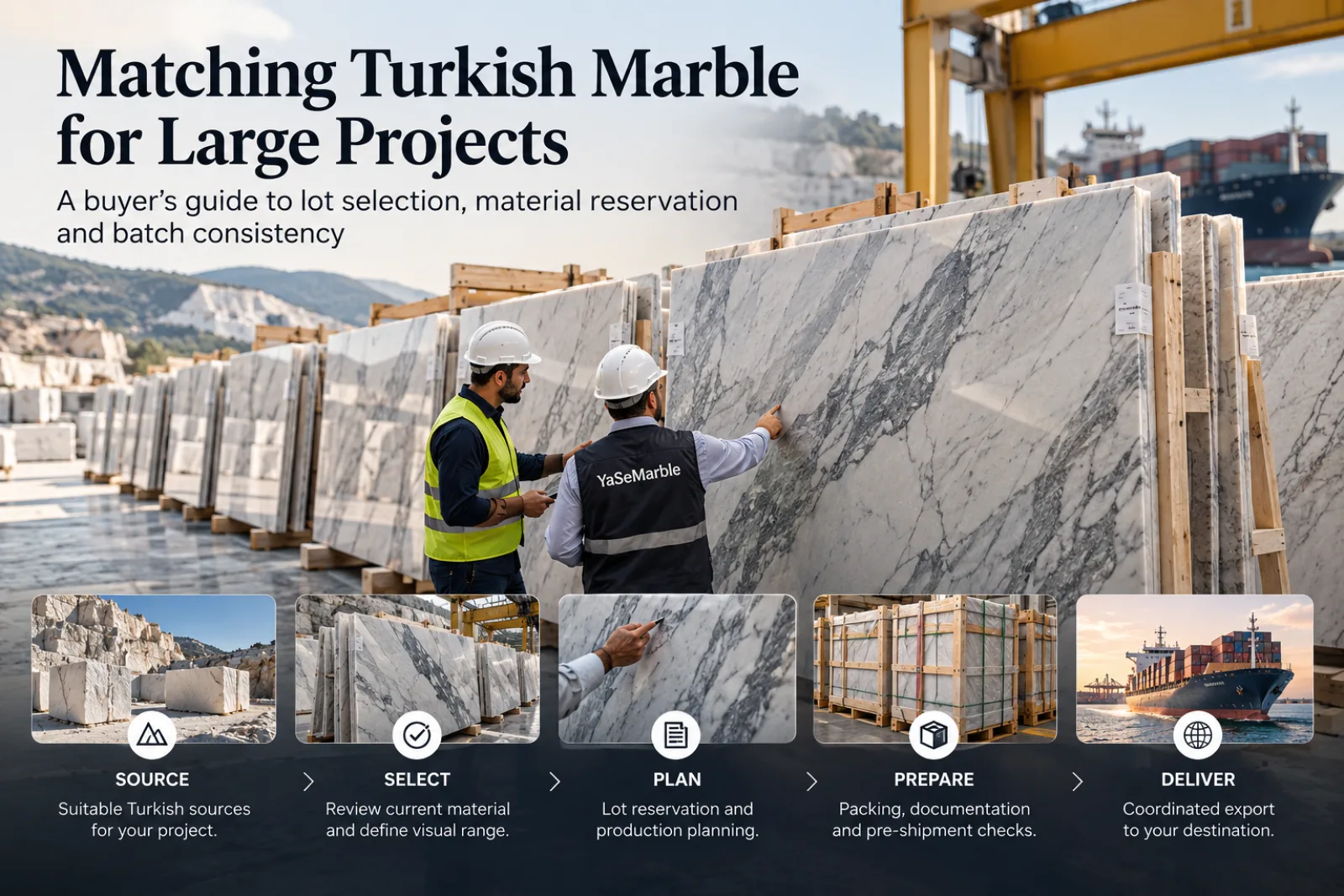
How to Secure Matching Turkish Marble for Large Projects
🖼️Blog Visuals
How to Secure Matching Turkish Marble for Large Projects
A buyer's guide to lot selection, material reservation and batch consistency
A marble sample can look perfect on a desk.
The real challenge starts when your project needs 500, 1,000 or 5,000 m² of natural stone.
Can the next shipment remain within the approved visual range?
Will the second production phase match the first?
Can enough material be sourced from the same production lot?
What happens if the approved material is no longer available when the next phase begins?
These questions should be addressed before production starts, not after the first container arrives.
For large architectural projects, buying marble is not simply a matter of choosing a stone name and agreeing on a price.
It is a material continuity and procurement planning problem.
Why Large Marble Orders Are Different
A small residential order may require a relatively limited quantity.
A hotel, residential development, commercial project or large villa can require hundreds or thousands of square metres across several production phases.
For example:
Phase 1: 800 m²
Phase 2: 1,200 m²
Phase 3: 1,000 m²
The total requirement is 3,000 m².
But the buyer may not want three unrelated production lots.
The project may require the material to remain within an agreed visual range throughout the building.
This is where many buyers make a critical mistake:
They approve the stone name instead of approving the material supply plan.
A commercial name such as Afyon White, Muğla White, Tundra Grey or another Turkish marble does not automatically define the visual range of every future block, slab or production lot.
Natural stone varies between blocks, production lots and slabs.
For large projects, the buyer should therefore define what material is acceptable and how future supply will be controlled.
1. Start With the Total Project Quantity
Before asking for a price, determine the real requirement.
Do not simply send:
“We need 2,000 m² of white marble.”
A professional project brief should include:
Total net quantity
Expected cutting waste
Required spare material
Delivery phases
Required installation date
Product form
Thickness
Finish
Dimensions
Intended application
Visual selection
Destination
Required documents
For example:
Stone: Turkish white marble
Application: Hotel lobby and guestrooms
Product: Slab
Thickness: 20 mm
Finish: Polished
Net requirement: 2,400 m²
Project spare: 5%
Delivery: Three phases
Destination: Dubai
Required first shipment: March 2027
The more complete the specification, the more meaningful the quotation.
2. Define the Visual Range — Not Just the Stone Name
This is one of the most important steps.
Instead of saying:
“First quality only.”
define what “acceptable” means.
For example:
Background colour
Light
Medium
Dark
Veining
Low
Medium
Strong
Natural features
Define whether the project accepts:
Small natural veins
Fossils
Minor natural openings
Controlled colour movement
And define which features require approval:
Large open fissures
Significant shade deviation
Heavy repairs
Unexpected resin treatment
Excessive colour movement
Terms such as “first quality”, “premium” and “A quality” are not universal visual standards.
The stronger approach is to define an approved visual range using actual material evidence.
3. Ask for the Current Lot — Not a Catalogue Photograph
A catalogue photograph answers:
“Does this stone exist?”
It does not answer:
“Is this exact material available for my project today?”
For a large order, ask for:
Current slab photographs
Current bundle photographs
Current block photographs where relevant
Video when appropriate
Dimensions
Available quantity
Selection information
Source information
Treatment information
For visually sensitive projects, a physical control sample and representative range samples may provide stronger approval than a single photograph.
This is particularly relevant to Turkish stones such as Afyon White, Afyon Sugar, Muğla White and Tundra Grey, where the commercial name alone should not be treated as a fixed visual specification.
Planning 500+ m²?
For projects requiring 500 m² or more, send your stone reference, quantity, product form, finish and destination.
Request a Project-Specific Quote →
YaSeMarble can review suitable Turkish sources and current material availability, subject to producer capacity and written commercial terms.
4. Discuss Lot Reservation Before Production
This is where large projects become different from ordinary purchases.
Imagine you approve a beautiful marble today.
You place the first order.
Six months later you need another 1,000 m².
The supplier says:
“The previous production lot is finished. We have another block.”
The stone may have the same commercial name.
But the colour, veining or movement may be different.
Now you have a project consistency problem.
Depending on the stone and producer, the supply plan may involve:
Current inventory reservation
A specific production lot
One or more selected blocks
Matched blocks
Phased production
Reserved material for later project stages
However, lot or material reservation is not an automatic guarantee by YaSeMarble.
Any reservation is subject to:
Current producer availability
Producer production capacity
Agreed reservation period
Payment or deposit requirements
Logistics feasibility
Written commercial agreement
YaSeMarble is a sourcing and export coordination business, not the owner of every quarry or factory represented in its collection.
5. One Block Is Not Always the Answer
A buyer may say:
“I want everything from one block.”
That sounds safe.
But it is not always practical.
A single block may not contain enough usable material for the entire project.
The better question is:
Can the supplier maintain the approved visual range across the required production quantity?
Depending on the stone, this may involve:
One block
Several matched blocks
A controlled production lot
Reserved inventory
Phased production
The correct solution depends on the stone, quarry, quantity and project requirements.
The objective is controlled consistency, not blindly insisting on one block.
6. Match the Cutting Direction
For some stones, the way the block is cut dramatically changes the appearance.
Vein-cut
Can produce a more linear and directional appearance.
Cross-cut
Can produce a more cloud-like and non-directional appearance.
If the project has a strong design intention, the cutting direction must be included in the specification.
For strongly veined materials, the buyer may also need to define:
Vein direction
Bookmatching
Dry layout
Panel sequence
Visible edges
Piece coding
For cut-to-size projects, drawings, BOQ, finish, tolerances and production instructions should be frozen before production begins.
7. Separate Natural Variation From Non-Conformity
Natural stone is not manufactured plastic.
Variation can be normal.
The project specification should therefore distinguish between:
Acceptable natural variation
Minor variation within the approved visual range.
Requires review
Significant deviation from the approved range.
Outside the agreed specification
Material that falls outside the written acceptance criteria.
The exact limits should be agreed for the project.
This protects both sides.
The buyer knows what is being approved.
The supplier knows what it is expected to deliver.
8. Plan the Project in Production Phases
Large projects should not necessarily be treated as one giant shipment.
Consider:
Phase 1
Lobby — 700 m²
Phase 2
Guestrooms — 1,500 m²
Phase 3
Public areas — 900 m²
The quotation should explain, where applicable:
Quantity per phase
Expected production date
Shipment date
Lot or material basis
Packing
Identification
Approval process
Documents
This is especially important when construction will continue over many months.
A low-priced first shipment is not necessarily a good deal if the second shipment cannot remain within the approved visual range.
9. Approve the Actual Material Before Loading
The final control point is before shipment.
Depending on the agreed scope, the buyer should be able to review evidence relating to the actual order.
This may include:
Current photographs
Video
Bundle identification
Quantity
Dimensions
Thickness
Finish
Selection
Packing
Labels
Loading photographs
Required documents
The goal is to confirm that the material being shipped corresponds to the agreed commercial specification before loading.
10. Your Quotation Should Define What You Are Actually Buying
A large-project quotation should not simply say:
White Marble — $XX/m²
A useful quotation should define, as applicable:
Product: slab, tile, block or cut-to-size
Stone/source: commercial stone name and confirmed source basis
Selection: agreed visual range or selection criteria
Thickness: nominal and/or finished thickness
Surface: polished, honed, brushed, leathered or other agreed finish
Dimensions: required sizes and applicable tolerances
Cut direction: vein-cut, cross-cut or other agreed orientation
Processing: edges, profiles, cut-outs, holes or other fabrication
Packing: bundle/crate basis and protection
Quantity: total quantity and shipment phases
Incoterm: agreed rule and named place/port
Loading port/place: for example Antalya, İzmir or Mersin where applicable
Payment terms: agreed deposit and balance structure
Offer validity: date or validity period
Production programme: estimated production and shipment timing
Inspection: agreed inspection or approval scope
Documents: technical/export documents that can actually be supplied
Exclusions: costs, services or responsibilities not included in the quotation
Two suppliers can quote the same marble at different prices because they are actually quoting different scopes.
The Large-Project Marble Checklist
Before approving a large Turkish marble order:
Material
☐ Exact stone identified
☐ Current material reviewed
☐ Visual range defined
☐ Finish defined
☐ Treatment defined
☐ Thickness defined
Supply
☐ Total project quantity calculated
☐ Production phases defined
☐ Lot/block basis discussed
☐ Reservation period defined
☐ Future replenishment risk considered
☐ Producer capacity confirmed where relevant
Production
☐ Cutting direction confirmed
☐ Drawings approved where required
☐ BOQ reconciled
☐ Tolerances defined
☐ Dry-layout/bookmatch requirements defined
☐ Piece coding defined where required
Commercial
☐ Price basis defined
☐ Incoterm defined
☐ Named port/place defined
☐ Payment terms defined
☐ Offer validity defined
☐ Exclusions defined
Before shipment
☐ Actual material reviewed
☐ Quantity checked
☐ Packing checked
☐ Required documents checked
☐ Loading evidence received
☐ Final approval recorded
Frequently Asked Questions
What is marble lot reservation?
Lot reservation means that a specific quantity of current or planned material may be set aside for a buyer under agreed commercial conditions.
It is not automatically a permanent guarantee of future supply. Availability, producer capacity, reservation period, payment status and written commercial terms must be confirmed for each order.
Does a large marble project have to come from one block?
No.
One block may not provide enough usable material for a large project. Depending on the stone and producer, a project may instead use matched blocks or controlled production lots.
The important point is to define the acceptable visual range before production.
Can the same marble name guarantee the same appearance?
No.
A commercial stone name does not guarantee identical colour, veining or movement from one block or production lot to another.
The current material and acceptable visual range should be reviewed before commercial approval.
Can YaSeMarble guarantee a future lot?
YaSeMarble does not own every quarry or factory represented in its sourcing network.
Any reservation or future-supply arrangement is subject to producer capacity, current availability, logistics and written commercial agreement.
For a large project, these conditions should be agreed before production begins.
Request Matching Turkish Marble for Your Project
If your project requires 500 m² or more of Turkish marble, travertine, limestone or onyx, send us:
Stone name or reference image
Product form
Quantity
Dimensions
Thickness
Finish
Visual preference
Destination
Required delivery date
Drawings or BOQ where applicable
YaSeMarble can review suitable Turkish sources and current material availability and coordinate a dated quotation according to the confirmed project requirements.