Vein-Cut vs Cross-Cut Travertine: Filled or Unfilled? A Buyer’s Guide to Turkish Travertine Specifications
🖼️Blog Visuals
Vein-Cut vs Cross-Cut Travertine: Filled or Unfilled? A Buyer’s Guide to Turkish Travertine Specifications
Publishing pack (EN) – for yasemarble.com/news
Vein-Cut vs Cross-Cut Travertine: Filled or Unfilled?
Ask three suppliers for a price on “Turkish travertine” and you may receive three quotes that cannot be compared. Nobody is lying. “Travertine” is only the starting point of a specification. How the block is cut, whether the natural voids are filled, and which finish is applied decide how the stone looks, how it performs and what it costs.
This guide covers the four decisions that define a travertine order, and shows how to write them down so that your quote, your sample and your shipment all describe the same stone. It also shows what you should be able to verify before you pay.
Why travertine needs more words than marble
Travertine forms from mineral-rich spring water, and it keeps the natural voids left by trapped gas and organic material. Those voids, together with the way the block is sawn, give each slab its character. Denizli is Turkey’s travertine heartland, and the same quarry can produce very different-looking material depending on the specification you choose.
Marble buyers can often rely on a stone name and a finish. For travertine, that is not enough.
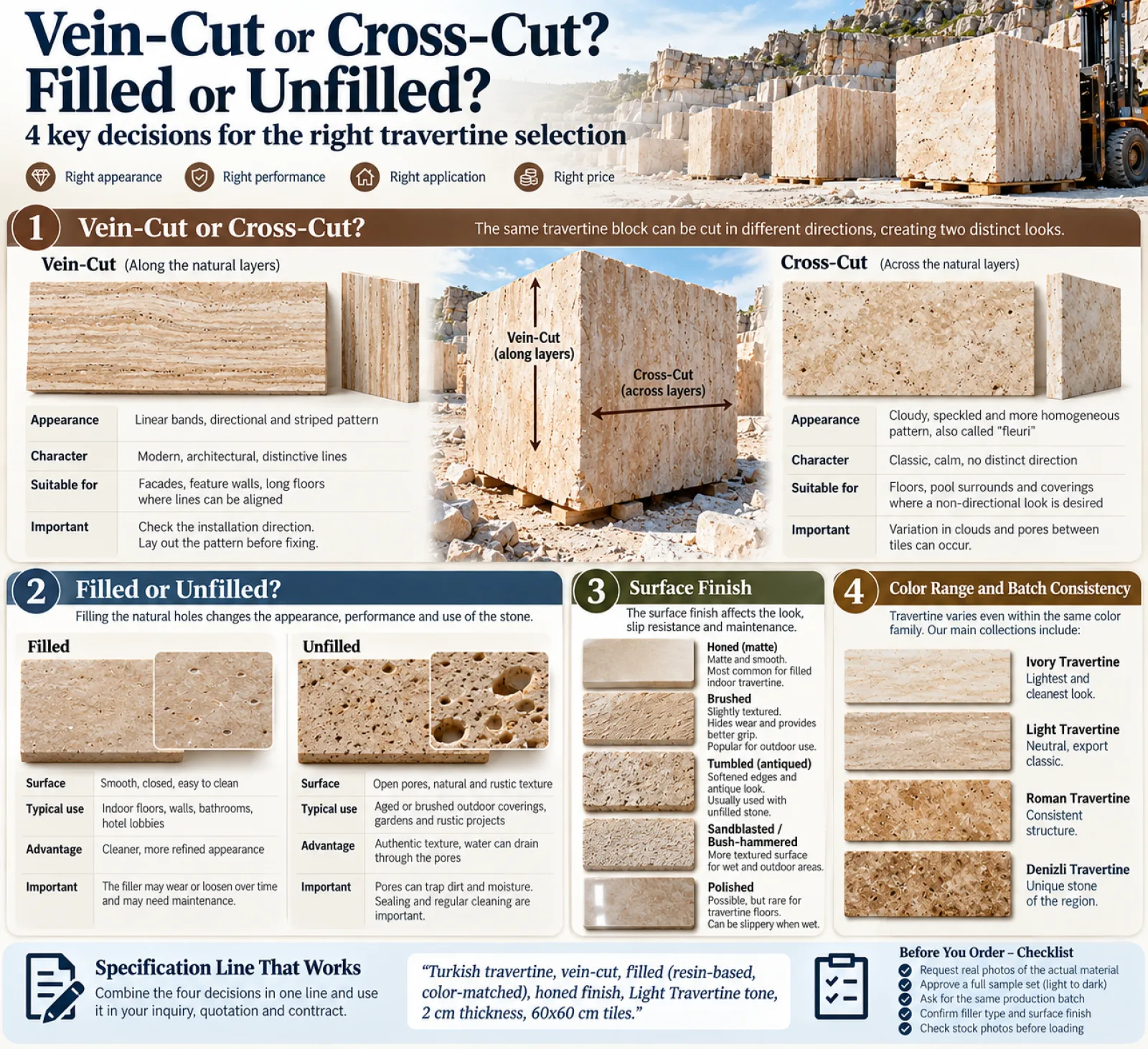
Decision 1: Vein-cut or cross-cut?
The block can be sawn in different orientations relative to the stone’s natural bedding. The result is two distinct looks:
Vein-cut | Cross-cut | |
|---|---|---|
Look | Linear banding, a striped and directional pattern | Cloudy, mottled and more uniform, often called “fleuri” |
Character | Contemporary, architectural, strong lines | Classic, calm, no obvious direction |
Works well for | Façades, feature walls, long floor runs where lines can be aligned | Floors, pool surrounds and paving where a non-directional look is preferred |
Watch out for | Installation direction. Lay out the pattern before fixing | Variation in cloud and pore distribution between tiles |
Practical advice: terminology varies between suppliers, so do not rely on the word alone. Ask for photos of the actual cut you will receive, and never mix vein-cut and cross-cut in the same visible area.
Decision 2: Filled or unfilled?
Filling means closing the natural voids with a colour-matched filler before the finish is applied.
Filled | Unfilled | |
|---|---|---|
Surface | Smooth, closed, easy to clean | Open pores, a natural and rustic texture |
Typical use | Interior floors, walls, bathrooms, hotel lobbies | Tumbled or brushed outdoor paving, garden and rustic projects |
Advantages | Cleaner, more refined appearance | Authentic texture, water can drain through the pores |
Watch out for | Filler can wear or loosen over time and may need refilling during maintenance | Pores collect dirt and moisture, so sealing and cleaning habits matter |
Two points that save arguments later:
Say what kind of filler you want (cement-based or resin-based, colour-matched, fully or partially filled). Ask your supplier which they use and why it suits your application.
Do not mix filled and unfilled material in one continuous surface. They age and clean differently.
For outdoor and cold-climate projects, discuss the filler choice with your supplier and fabricator before ordering.
Decision 3: Which finish?
Finish changes the look, the slip behaviour and the maintenance.
Honed: matte and smooth, the most common choice for filled interior travertine.
Brushed: a lightly textured surface that hides wear and gives more grip, popular outdoors.
Tumbled: softened edges and a worn, antique feel, usually paired with unfilled stone.
Sandblasted or bush-hammered: a rougher texture for wet or exposed areas.
Polished: possible, but uncommon on travertine floors because it can become slippery when wet.
For wet areas such as pool surrounds, choose a textured finish and confirm any slip-resistance requirement of your project in writing. Our guides on marble finishes and travertine pool pavers and coping go deeper.
Decision 4: Shade range and lot consistency
Travertine varies within a colour family. Our collections cover the main tones: Ivory Travertine for the lightest, cleanest look, Light Travertine as the neutral export classic, Roman Travertine for consistent structure, and Denizli Travertine for the regional original.
To keep the shipment close to what you approved:
Approve a sample set that shows the range, from lightest to darkest, not a single perfect tile.
Ask for the full quantity to come from the same production lot where the project is sensitive to shade.
Request photos of the actual stock before loading.
A specification line that works
Write all four decisions into one line and put it in the enquiry, the quotation and the contract:
Turkish travertine, Light tone, vein-cut, fully filled with colour-matched filler, honed, example size 60 × 40 × 3 cm, calibrated, first selection, wooden crate packing, shade range as per approved sample set.
When every supplier quotes against the same line, the prices become comparable. Our guide to comparing Turkish marble quotes shows what else to check.
Download: Travertine Specification Sheet (PDF). A one-page, fill-in sheet with the four decisions, shade range and packing, ready to send to any supplier. [Download free](PDF LINK)
Ready to quote? Send us your specification line: info@yasemarble.com or WhatsApp +90 552 802 22 00.
Verified Before You Buy: what you should receive before you pay
A specification is only useful if it is verified. For every travertine order, expect:
Photos (and video where needed) of the actual cut, fill and finish, not catalogue images.
The full specification line written into the quotation.
A sample set showing the lightest-to-darkest range.
The producer’s technical data for the specific quarry and product, where available.
Photos of the actual stock before loading.
If a supplier cannot show these, you are comparing promises, not stone. Our guide How to Verify Marble Before Buying applies the same checklist to every natural stone order.
Quick chooser by application
A typical starting point, to be confirmed against your project requirements:
Application | Typical starting specification |
|---|---|
Interior floors and walls | Filled, honed, vein-cut or cross-cut by design preference |
Bathrooms and wet rooms | Filled, honed or lightly brushed, sealed after installation |
Façade cladding | Vein-cut for strong lines or cross-cut for calm continuity, filled or unfilled by detail |
Pool surrounds | Textured finish such as brushed or tumbled, filler choice agreed with the supplier |
Terraces and garden paving | Brushed or tumbled, often unfilled, sealed and maintained |
Feature walls | Vein-cut with a dry layout approved before fixing |
Climate and destination matter. For northern Europe, Russia and other freeze-thaw regions, discuss filler type, water absorption and frost behaviour with us before ordering. For hot, sunny regions such as the Gulf, prioritise a textured finish on exposed surfaces and light tones, and plan sealing. Tell us the destination and we will suggest a suitable starting specification.
Common mistakes
Ordering “travertine” without naming cut, fill and finish.
Comparing quotes that describe different stones.
Approving a single sample instead of the real range.
Mixing filled and unfilled, or two cuts, in one visible area.
Skipping sealing and installation planning. See our installation guide and maintenance guide.
How Yase Marble helps
We work directly with 14 verified producers, so we can match your specification to the right quarry and factory instead of guessing from a catalogue photo. We share real photos of the cut, fill and finish you are buying, put those details into the quotation line, and quote FOB or CIF. You decide with facts in hand, which is the idea behind Verified Before You Buy.
Planning a shipment? See how much stone fits in a container.
Frequently asked questions
What is the difference between vein-cut and cross-cut travertine? Vein-cut shows linear banding and a directional, striped look. Cross-cut shows a cloudy, more uniform look. Both come from the same stone, sawn in different orientations.
Is filled travertine better than unfilled? Neither is better in general. Filled suits clean, refined interiors. Unfilled suits rustic and textured outdoor use. The right choice depends on application and climate.
Can I use travertine around a pool? Yes, travertine is widely used for pool surrounds. Choose a textured finish, agree the filler with your supplier and seal as recommended.
Which finish is best for outdoor travertine? Brushed and tumbled finishes are the most common because they give more grip and hide wear.
How do I make sure the shipment matches my sample? Approve a sample set showing the shade range, write the full specification into the quotation, request same-lot supply where shade matters and ask for photos of the actual stock before loading.
What should I ask a supplier for before paying? Photos of the actual cut, fill and finish, the full specification line in the quotation, a sample set showing the shade range, producer technical data where available, and photos of the real stock before loading.
Get a travertine quote that matches your specification
Send us: application, approximate quantity, size and thickness, destination port, and your specification line (or the downloaded sheet). Not sure about cut or fill? Tell us about the project and we will propose options.
You receive: photos of the real stock, a quotation with your full specification line, and an FOB or CIF price.
Request a quote · WhatsApp: +90 552 802 22 00 · Email: info@yasemarble.com